


Notice in the app.
Begin with the script. Practice recognizing letters and core vocabulary, then return for review. Mastery counts only when recognition holds after a time gap.
Explore app availability →A passage you want to study. A history you want to recover. A question worth following. Let it become your reason to begin.
Scriptorium Language Lab trains recognition of research-language alphabets and core vocabulary, confirmed across days.
Try a word here. No account needed.Recognition precedes reading.
One letter. One word. Across days.Where it was written · Lake Tana region, Ethiopia
Gospel book, late 14th–early 15th c.; now at the Metropolitan Museum of Art · map, Hondius, 1619
Book of the Gospels, Lake Tana region, Ethiopia, late 14th–early 15th century. The Metropolitan Museum of Art, 1998.66. Open Access, CC0.
See the catalogue recordPractice in the app. Write by hand. Keep your reason for learning in view.
The language is a beginning. The texts, people, and questions beyond it are your reason to keep going.
Greek and Hebrew are a path toward studying biblical texts in their own languages. Think of the Greek pages of Codex Sinaiticus, or Hebrew texts preserved among the Dead Sea Scrolls. Begin with the letters. Build toward the questions that brought you here.
Begin with Koine Greek or Biblical Hebrew in Scriptorium. Train the alphabet, then core vocabulary, alongside your grammar or course.
These are horizons for continued language study. Scriptorium builds the recognition foundation; your grammar, teacher, and work with texts carry the journey further.
See which sources each language opens, period by period →One right answer is a beginning. Scriptorium returns to the letter or word across days until recognition lasts. Watch the 45-second film, then try a word for yourself.
The film has music and effects but no spoken narration. Its essential lines appear on screen.
a word, speech, the Word
Look at the word and its gloss. When you’re ready, try recognizing it.
A website sample · No account or saved progressYou do not have to face an entire language today. Start by noticing one word. Recognize it again. Return after time has passed.
That is the habit Scriptorium is built to support: focused practice, spaced repetition, and mastery that earns its name.
Continue with the Scriptorium appThe full app begins with the script before vocabulary. This isolated-word sample introduces the recognition loop; it does not teach translation or save mastery.
The lemma occurs in the SBL Greek New Testament. Gloss from the app’s public-domain Dodson vocabulary source: “a word, speech, the Word.” A short gloss is not an explanation of every use in context.
A quiet daily rhythm connects the screen and the desk. Each part has a purpose.
Begin with the script. Practice recognizing letters and core vocabulary, then return for review. Mastery counts only when recognition holds after a time gap.
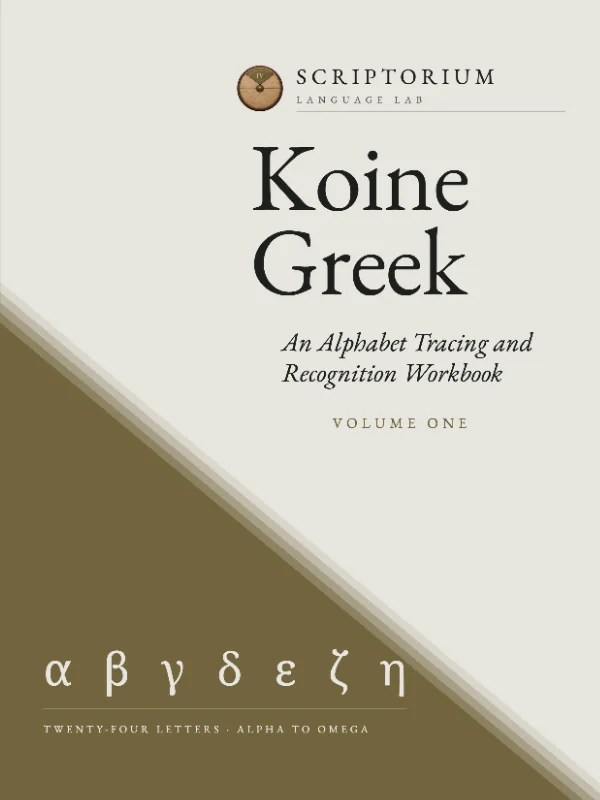
Explore app availability →Bring focused practice to your desk. The recognition workbook collection is being prepared for writing by hand alongside the app.
Coming in printExplore the workbooks →Use this website to explore the languages, find your starting point, and connect your practice to the sources you hope to study.
Find your reason to learn →Bring the recognition habit alongside the curriculum you already love. Explore Scriptorium for families and co-ops, ages 13 and up, and for teachers.
Let the question that brought you here become the practice you return to.
Begin with one word Explore all eight languages